The problem
In an ajo, esusu or tontine, one organiser collects from every member each round and holds the pot until it's paid out. The circle's savings depend on her, and so does the work of chasing late payers and proving who paid.
A rotating savings circle (ajo, esusu, tontine) on Bitcoin Lightning where nobody holds the pot. Each member's own wallet pays that round's payee directly.
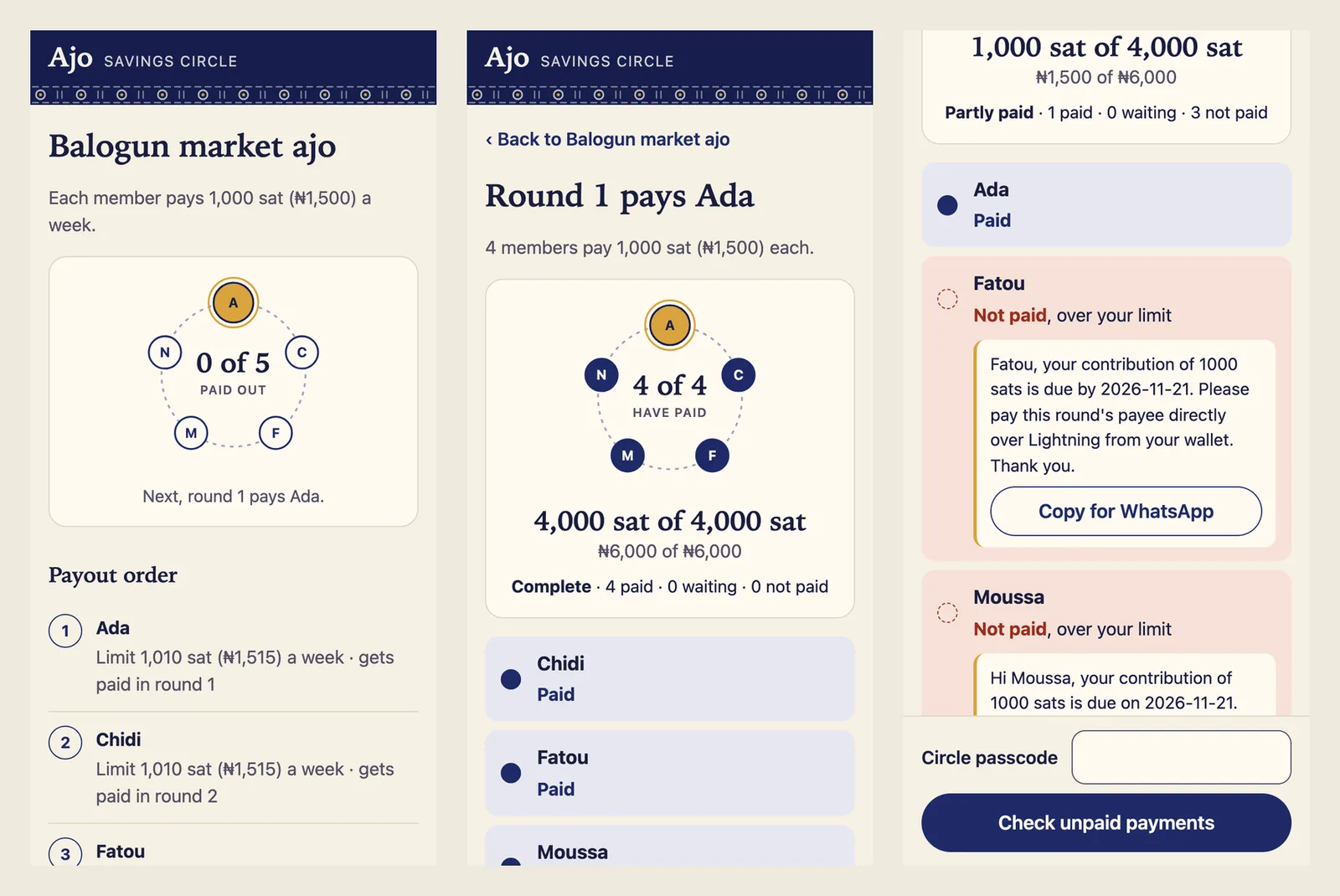
In an ajo, esusu or tontine, one organiser collects from every member each round and holds the pot until it's paid out. The circle's savings depend on her, and so does the work of chasing late payers and proving who paid.
Ajo on Lightning is for the circle organiser, often the woman who already runs a market traders' ajo with 5 to 20 members. Today she visits stalls or waits for transfers, holds the pot, calls late payers and is the only record of who paid.
The organiser types the circle's passcode and presses Collect this round. Each member's wallet pays the payee, and each row turns to Paid. If a payment can't go through, the row says why, for example that it's over the member's weekly limit.
Each payment uses a hold invoice, so the payee's wallet holds the money until the round releases it. A late payment is never released, and running the round again never creates a second invoice for the same member.
For anyone who hasn't paid, Claude Haiku writes a short reminder in the circle's language, ready to copy into WhatsApp. The model sees only the language, the seat, the amount and the due date. The server adds the member's name afterwards.
The repo has unit tests, an end-to-end script that checks the payee's hub and the relay directly, and a TLA+ model that holds all five payment rules over 7,280,499 states.
It runs on regtest only, with fixed passwords, so it isn't safe for real money as it stands. One stack runs one circle, and the organiser starts each round by hand.