This post follows Building the Kubernetes Multi-Cluster Plugin for PipeCD. Part 1 covered the six progressive delivery stages. This post covers the work that came after, which made those stages more flexible, easier to debug, and more reliable.
Where Part 1 Left Off
At the end of Part 1, the plugin could run Canary, Baseline, Primary, Traffic Routing, and their cleanup stages on all clusters at the same time. However, every stage always ran on every cluster, and when something failed, the plugin did not tell you which cluster failed.
Part 1 ended by listing the next steps: DetermineStrategy and drift detection. This post covers both. It also covers plan preview, Helm/OCI authentication, config validation, health checks for all workload types, better rollback, and settings you can set per cluster.
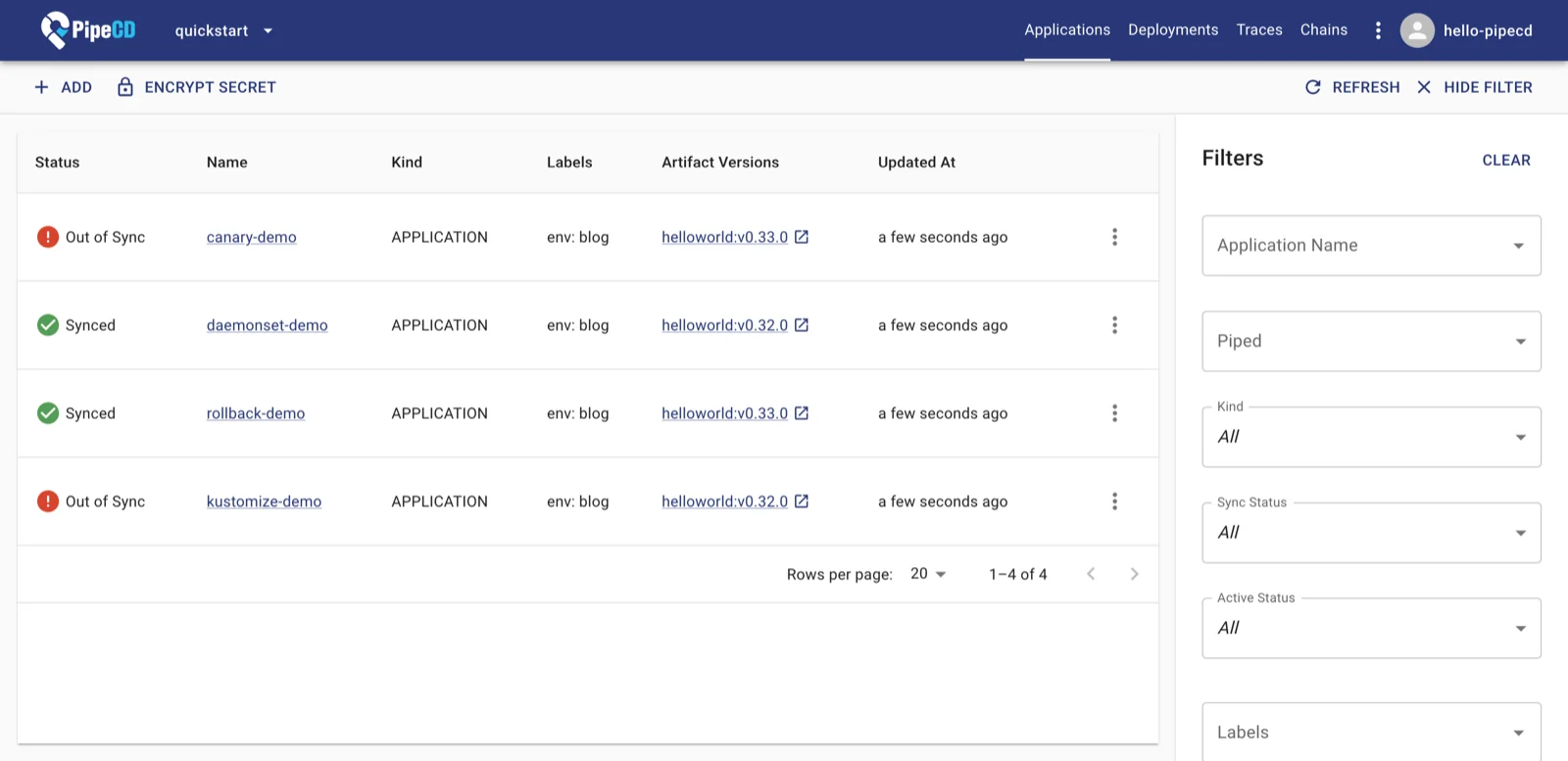
All screenshots in this post come from a local setup. It has a PipeCD control plane in one kind cluster, and one piped that deploys to two more kind clusters. These two clusters are registered as the deploy targets cluster-eu and cluster-us.
Per-Stage Cluster Filtering
Every stage ran on every cluster. In a real pipeline, you may want the canary to run only on cluster-eu, the baseline only on cluster-us, and the primary rollout on all clusters.
PR #6757 added a multiTargets option to each stage:
stages:
  - name: K8S_MULTI_CANARY_ROLLOUT
    with:
      multiTargets: ["cluster-eu"]
  - name: K8S_MULTI_BASELINE_ROLLOUT
    with:
      multiTargets: ["cluster-us"]
  - name: K8S_MULTI_PRIMARY_ROLLOUT
    # no multiTargets = all clusters
Each stage keeps only the clusters that are both in its multiTargets list and in the application's deploy targets. If multiTargets is empty, the stage runs on all clusters. This is the same as the old behaviour, so existing pipelines keep working.
The filtering happens before the stage starts applying changes. Clusters that are not in the list are never touched. This prevents rollout to an unintended cluster; selected clusters can still be partially updated if an apply fails after earlier resources have succeeded. In the config code, every stage options type has an optional MultiTargets []string field:
type K8sCanaryRolloutStageOptions struct {
    Replicas      unit.Replicas `json:"replicas"`
    Suffix        string        `json:"suffix" default:"canary"`
    CreateService bool          `json:"createService"`
    Patches       []K8sResourcePatch `json:"patches"`
    // Empty means all deploy targets.
    MultiTargets  []string      `json:"multiTargets,omitempty"`
}
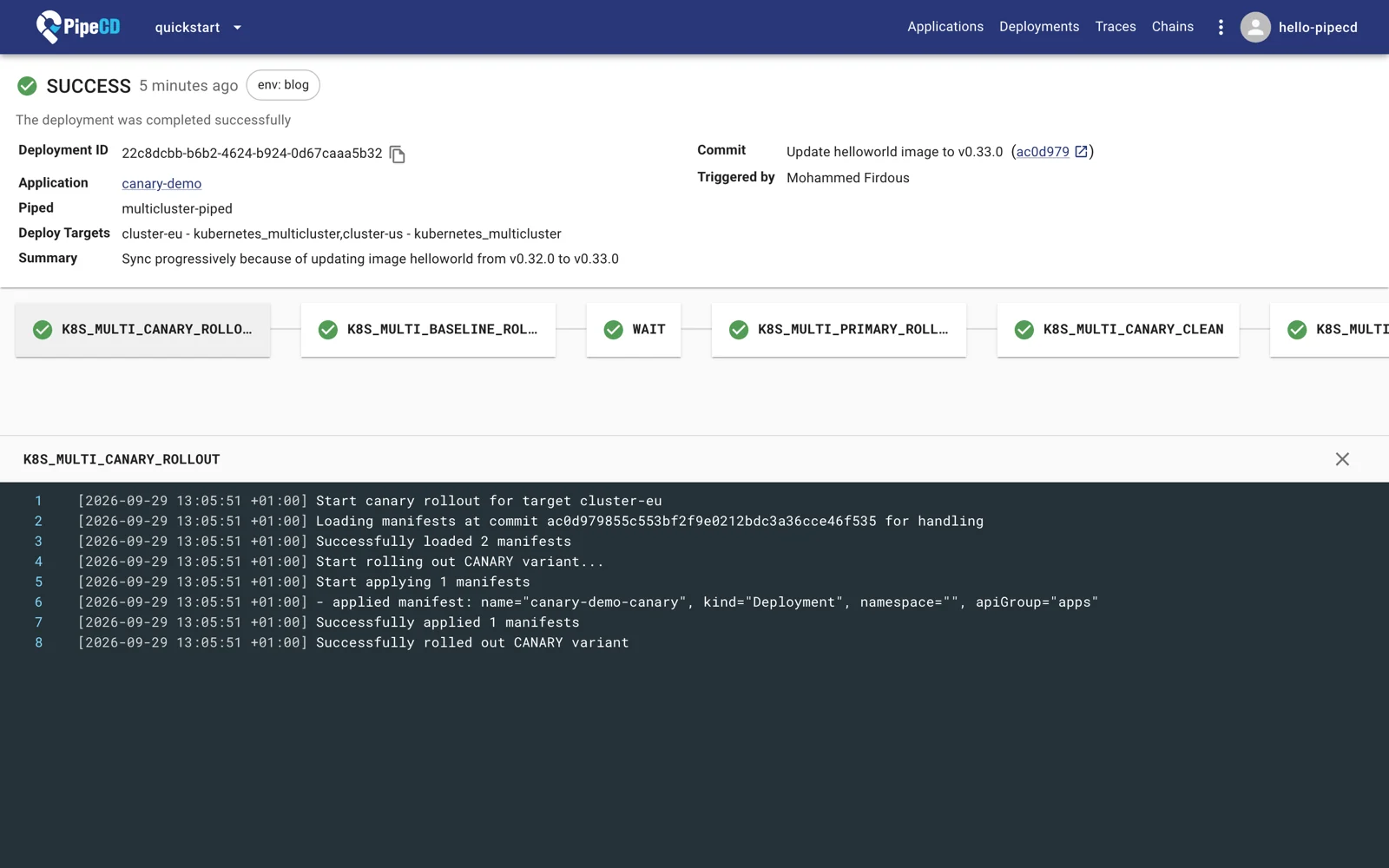
The canary stage log only mentions cluster-eu:
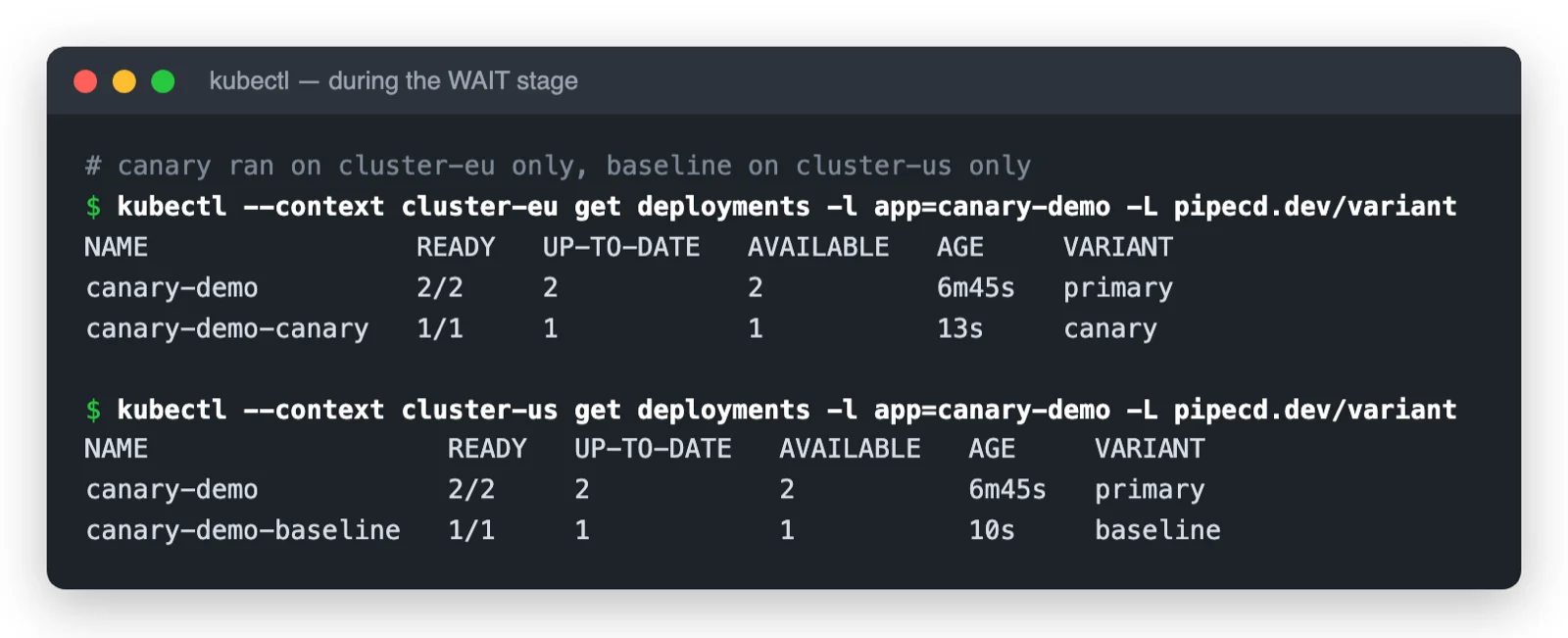
While the pipeline is paused, you can check the clusters directly. The canary exists only on cluster-eu, and the baseline exists only on cluster-us.
Per-Cluster Visibility: DeployTargetStatus in the SDK
When a stage ran on several clusters and one of them failed, you got a single combined error and had to work out which cluster caused it.
PR #6861 added a DeployTargetStatuses field to the plugin SDK's ExecuteStageResponse:
type DeployTargetStatus struct {
    // Name is the deploy target name.
    Name    string
    // Status is the outcome for this specific target.
    Status  StageStatus
    // Message is an optional human-readable detail.
    Message string
}
PR #6812 used this field in the five stages that run on clusters in parallel: sync, canary rollout, baseline rollout, primary rollout and traffic routing. The cleanup and rollback stages still return only the overall status. The stage dispatch in plugin.go now looks like this:
case StageK8sMultiCanaryRollout:
    status, dtStatuses := p.executeK8sMultiCanaryRolloutStage(ctx, input, dts)
    return &sdk.ExecuteStageResponse{
        Status:               status,
        DeployTargetStatuses: dtStatuses,
    }, nil
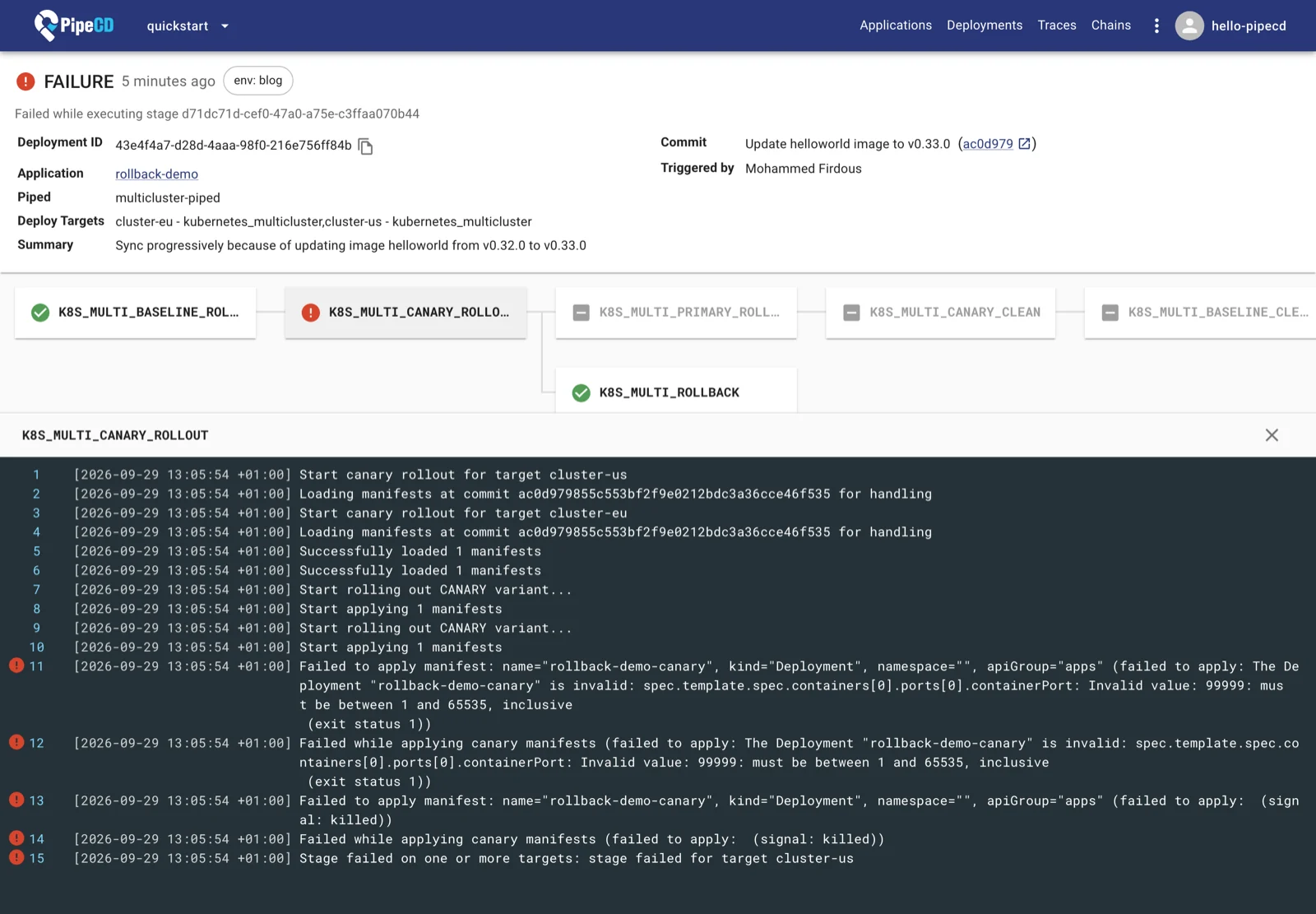
Those stages now return a status for each cluster, together with the overall status. The stage log also names the cluster that failed. In the run below, cluster-us got a manifest that the API server rejects. The stage fails, and the log shows which cluster caused the failure. The apply that was still running on cluster-eu is cancelled instead of being left to finish:
Right now, the plugin returns these per-cluster statuses through the SDK. Showing them in a separate per-cluster view in the web UI is planned as future work.
Plan Preview
Before running a pipeline, operators often want to see which manifests will be added, updated, or removed, without applying anything. PipeCD supports this with its plan preview API.
PR #6685 added plan preview to the multi-cluster plugin. It returns one diff for each deploy target instead of one combined diff. cluster-eu and cluster-us can load different manifests, so their diffs can be different, and one combined diff would hide that.
// Multi-target: produce one PlanPreviewResult per deploy target.
results := make([]sdk.PlanPreviewResult, 0, len(dts))
for _, dt := range dts {
    newManifests, err := loadManifests(ctx, loader, input, &targetDS, targetSpec, mt)
    // ...
    result, err := provider.DiffList(oldManifests, newManifests, ...)
    results = append(results, toResult(result, dt.Name))
}
return &sdk.GetPlanPreviewResponse{Results: results}, nil
Each result includes the deploy target name, a summary, and the full diff, with secrets hidden. If no multiTargets are set, the plugin loads the manifests once and returns a single result.
In this example, a branch changes the replica count for cluster-eu only:
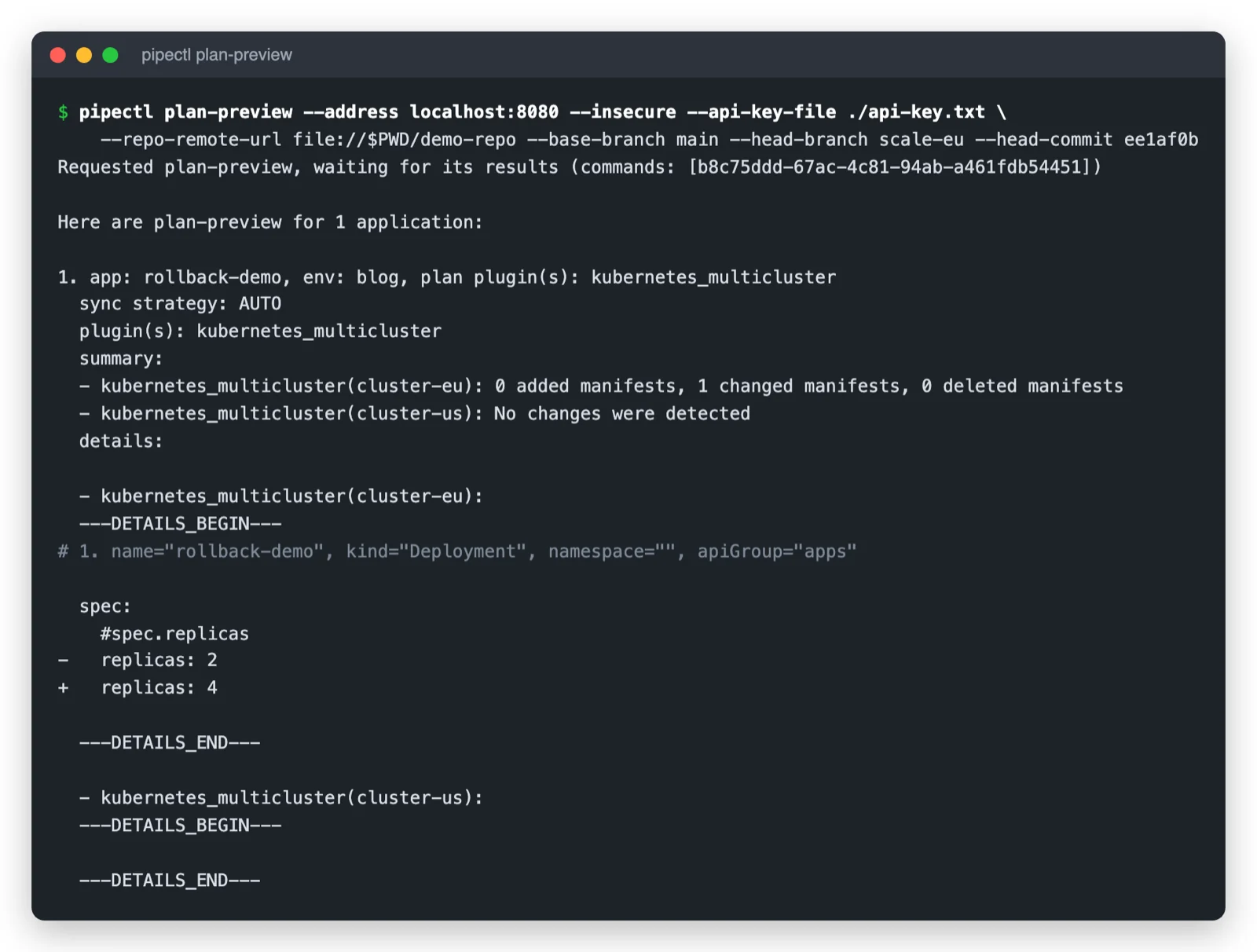
One gap turned up while taking that screenshot: the preview applied the per-cluster manifests override but not the per-cluster kustomizeDir, kustomizeVersion and kustomizeOptions that the deployment path already used, so applications with per-cluster Kustomize overlays always previewed as "No changes". #7437 makes the preview use the same per-cluster settings as the deployment, so per-cluster Kustomize overlays show up in the preview too.
Helm/OCI Initializer Hook
The plugin's Initialize hook runs once when piped starts, before any deployment. PR #6723 added Helm repository setup and OCI registry login to this hook.
func (i *initializer) Initialize(ctx context.Context,
    input *sdk.InitializeInput[...]) error {

    helm := provider.NewHelm("", helmPath, input.Logger)

    // Add and update HTTP Helm chart repositories.
    for _, repo := range input.Config.HTTPHelmChartRepositories() {
        if err := helm.AddRepository(ctx, repo); err != nil {
            return err
        }
    }
    helm.UpdateRepositories(ctx)

    // Log in to OCI registries.
    for _, registry := range input.Config.ChartRegistries {
        if !registry.IsOCI() {
            continue
        }
        if err := helm.LoginToOCIRegistry(ctx,
            registry.Address, registry.Username, registry.Password); err != nil {
            return err
        }
    }
    return nil
}
You set both of these once, at the plugin level in the piped config:
plugins:
  - name: kubernetes_multicluster
    config:
      chartRepositories:
        - name: demo-charts
          address: http://127.0.0.1:8879
      chartRegistries:
        - type: OCI
          address: localhost:5002
          username: piped
          password: <registry-password>
Because login happens in Initialize, it runs once at startup, not on every deployment. In the screenshot below, the helm binary that piped uses is first rejected by a password-protected registry. After piped starts and the hook runs, the same binary can pull from it:
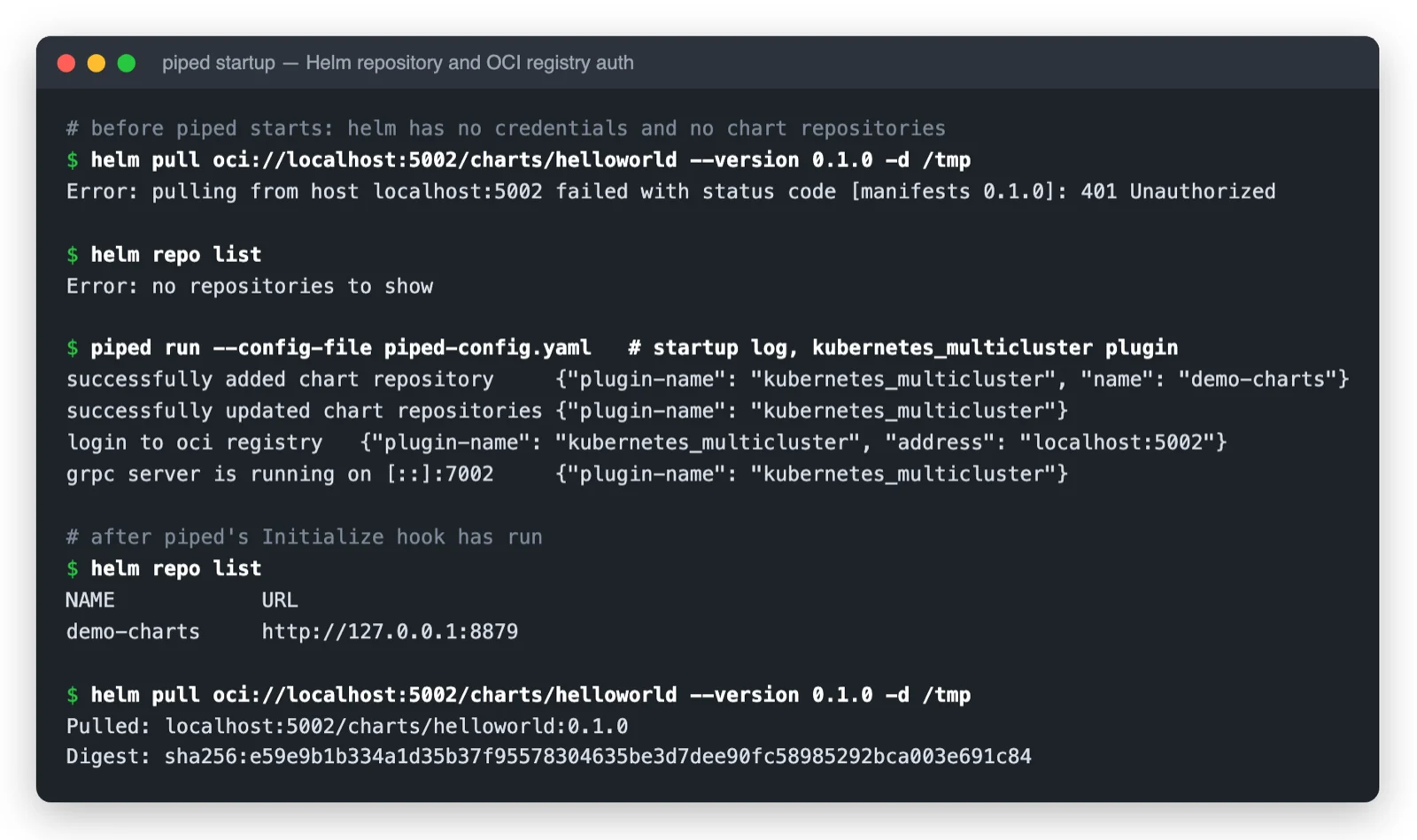
This login is also the groundwork for remote charts. Today the plugin renders charts from the application directory (helmChart.path). Rendering a chart straight from a repository or OCI registry through helmChart.repository, name and version, reusing the login done here, is in review in #7465.
Config Validation
PR #6747 added a Validate() method to KubernetesApplicationSpec. It catches two kinds of mistakes when the config is read, instead of later during the deployment:
func (s *KubernetesApplicationSpec) Validate() error {
    // helmChart and kustomizeOptions are mutually exclusive.
    if s.Input.HelmChart != nil && len(s.Input.KustomizeOptions) > 0 {
        return errors.New("helmChart and kustomizeOptions are mutually exclusive")
    }
    // Every multiTarget entry must have a name.
    for i, mt := range s.Input.MultiTargets {
        if mt.Target.Name == "" {
            return fmt.Errorf("multiTargets[%d].target.name must not be empty", i)
        }
    }
    return nil
}
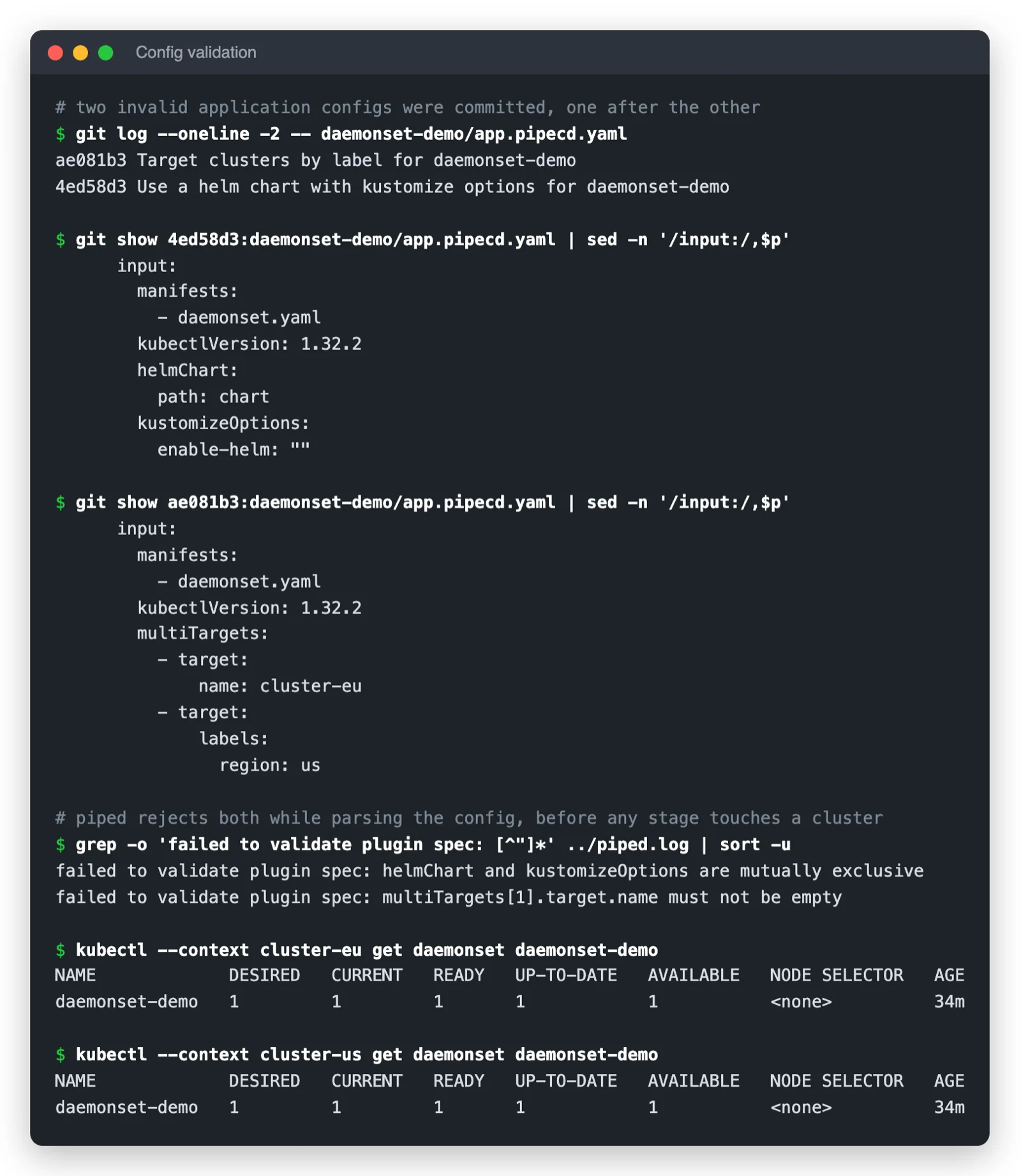
The first check stops you from setting both a Helm chart and Kustomize options in the same spec, because the two cannot be used together. The second check makes sure every multiTargets entry has a name, so the filtering has something to match.
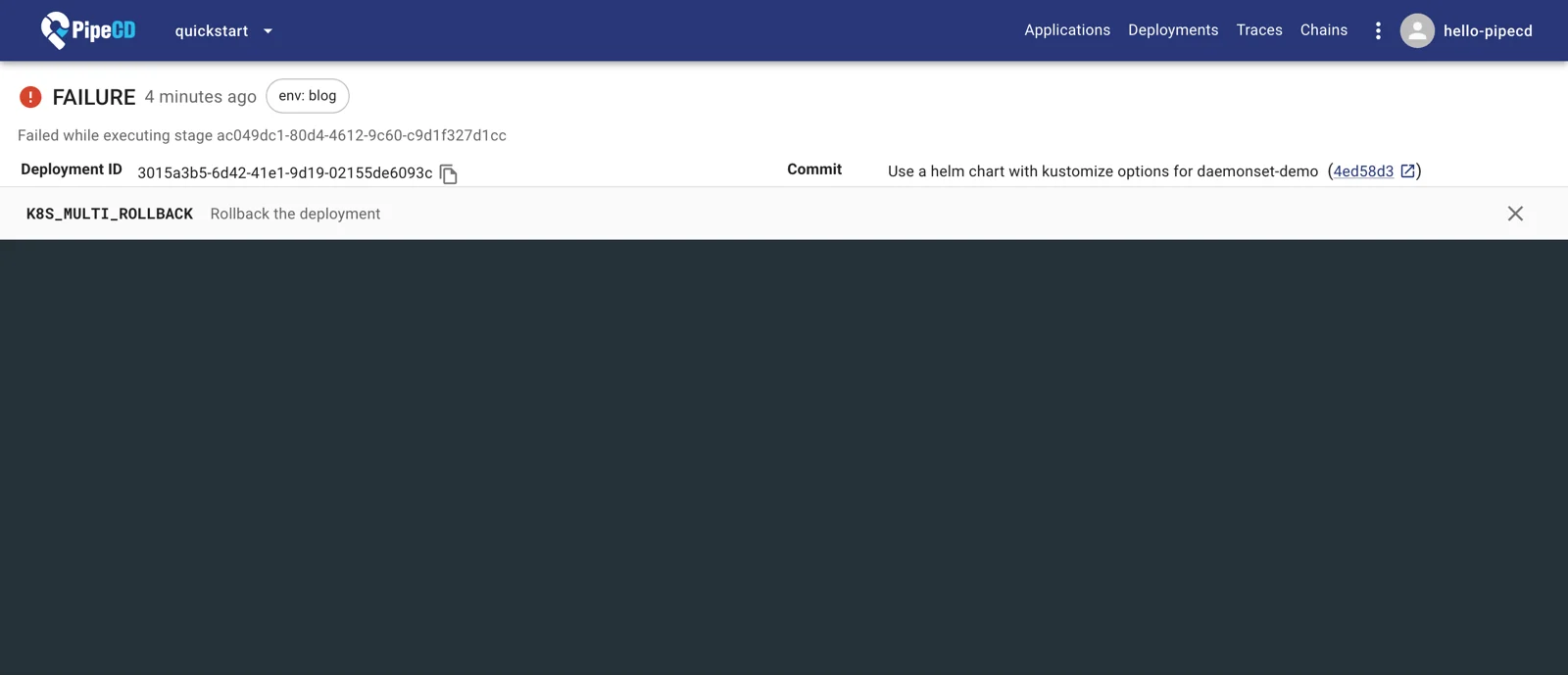
If you commit a config that breaks either rule, the deployment fails while the config is being read. No stage reaches any cluster:
The piped log shows the reason. The workload that was already running stays the same on both clusters:
Better Rollback
In Part 1, rollback restored the previous primary. Two things were missing.
Removing leftover resources (#6748): a resource might exist in the previous deployment but be removed from Git before the rollback. In that case, it stayed in the cluster. Now rollback compares what is running with what should be running after the rollback, and deletes anything extra.
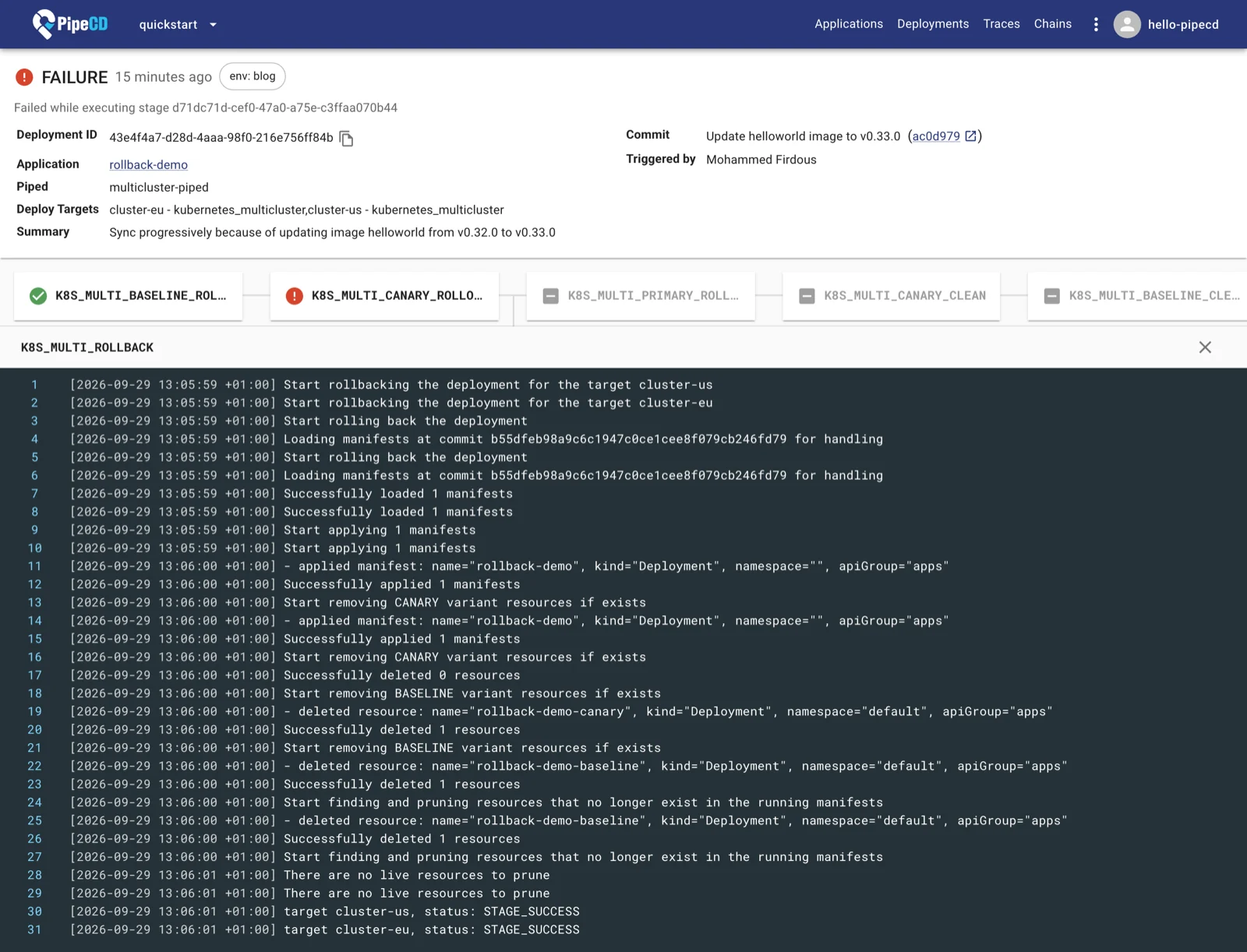
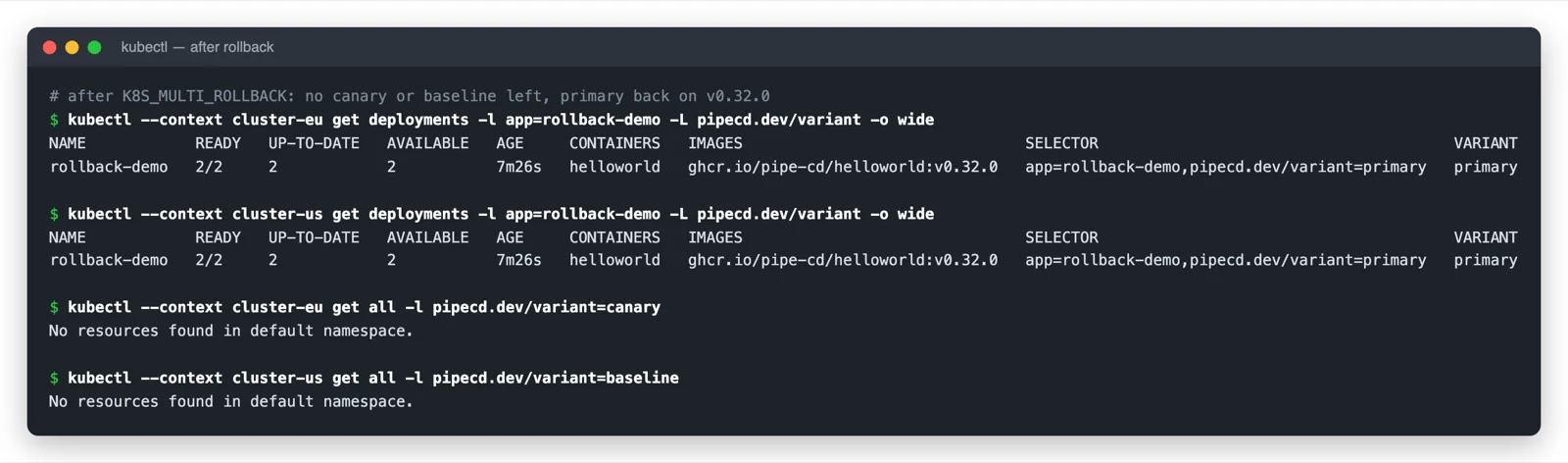
Cleaning up Canary and Baseline (#6660): if a pipeline fails halfway, the canary and baseline pods keep running on the clusters that got them. Before, rollback only restored the primary. Now, after it re-applies the previous primary manifests, rollback also finds and deletes all variant=canary and variant=baseline resources on every cluster.
The screenshot below shows the rollback after the failed canary stage from earlier. The baseline had been rolled out to both clusters, and the canary had reached cluster-eu. Rollback removes all of them:
Health Checks for All Workload Types
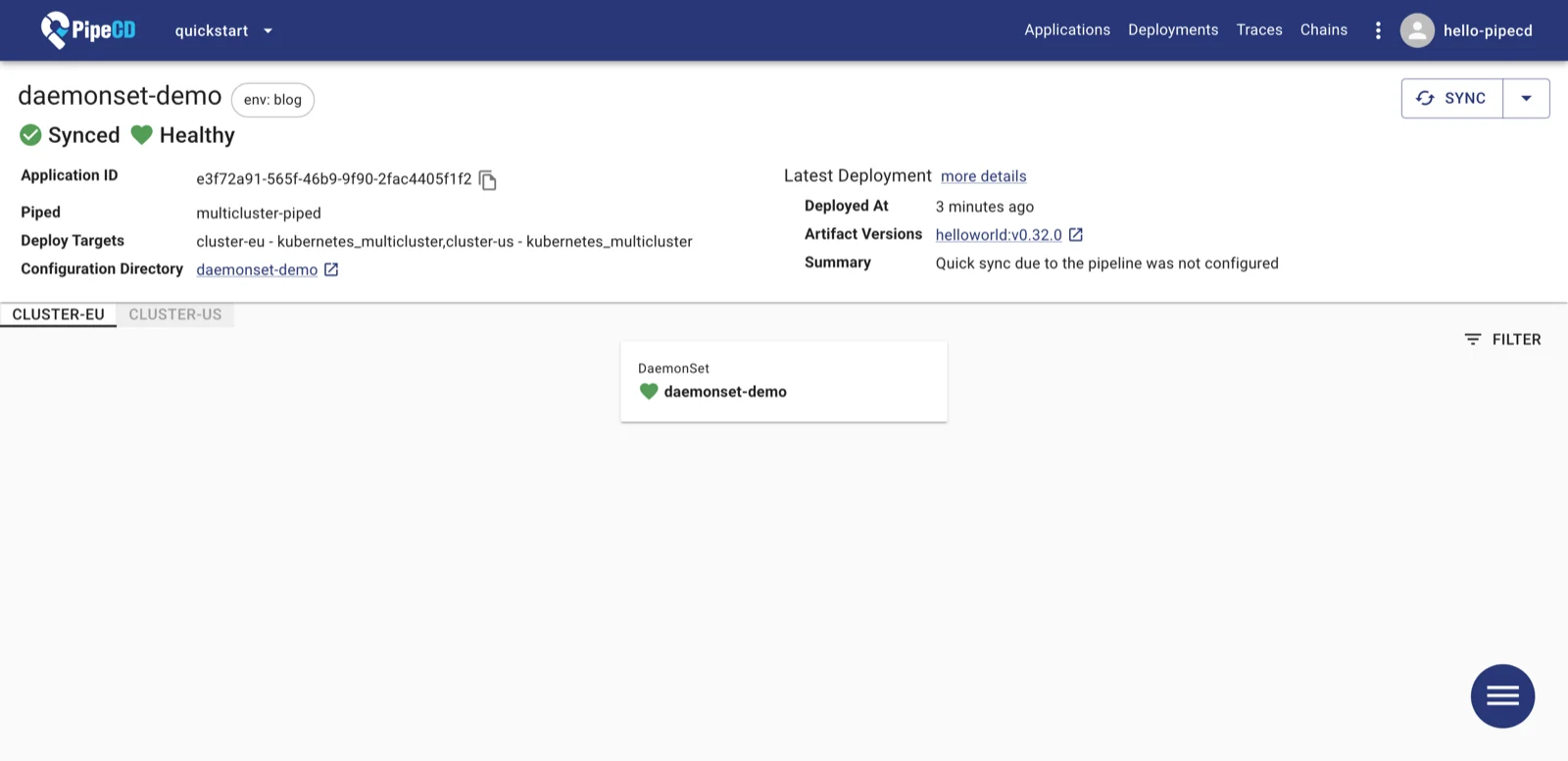
The plugin checked the health of Deployments and StatefulSets, but it skipped DaemonSets, ReplicaSets, and Pods without any warning. PR #6807 added the missing checks:
- DaemonSet: unhealthy while the observed generation is behind, while fewer pods are updated or available than
DesiredNumberScheduled, or while any pod is misscheduled or unavailable. Healthy otherwise. - ReplicaSet: unhealthy while the observed generation is behind, when a
ReplicaFailurecondition is set, or while the available or ready replicas are not equal to the desired count. Healthy otherwise. - Pod: unhealthy when a container is waiting with an error reason such as
CrashLoopBackOfforErrImagePull, or when the pod phase is anything other thanRunningorSucceeded.
Before this change, those kinds fell through to Unknown with the reason "Unimplemented or unknown resource", so a DaemonSet that could not start on half of the nodes looked the same as one that was fine. Kinds that still have no health check show up that way; the Endpoints and EndpointSlice objects in the drift screenshot below are an example.
Drift Detection
The plugin reads the live state of a cluster by selecting the resources that carry the pipecd.dev/managed-by and pipecd.dev/application labels PipeCD adds at deploy time. That selection is the same on every cluster, so PR #6673 added two ways to narrow it. A deploy target can list which kinds to watch or skip with appStateInformer.includeResources and excludeResources in the piped config:
deployTargets:
  - name: cluster-eu
    config:
      kubeConfigPath: /path/to/cluster-eu.yaml
      appStateInformer:
        excludeResources:
          - kind: Endpoints
          - apiVersion: discovery.k8s.io/v1
            kind: EndpointSlice
And a single resource can opt out of the comparison with the annotation pipecd.dev/ignore-drift-detection: "true".
PR #6672 updated DetermineStrategy to handle multiple clusters. Before, it loaded the manifests once without any per-cluster override, so with per-cluster manifests or kustomizeDir a change in one cluster's manifests could be missed and the deployment would run as a QuickSync, skipping the canary and baseline stages. Now it loads the manifests for each cluster and uses the full pipeline if any cluster has a workload change.
Drift is shown for each cluster. In this example, someone ran kubectl scale on cluster-us only. The diff for cluster-us shows replicas: 4, while Git says 2:
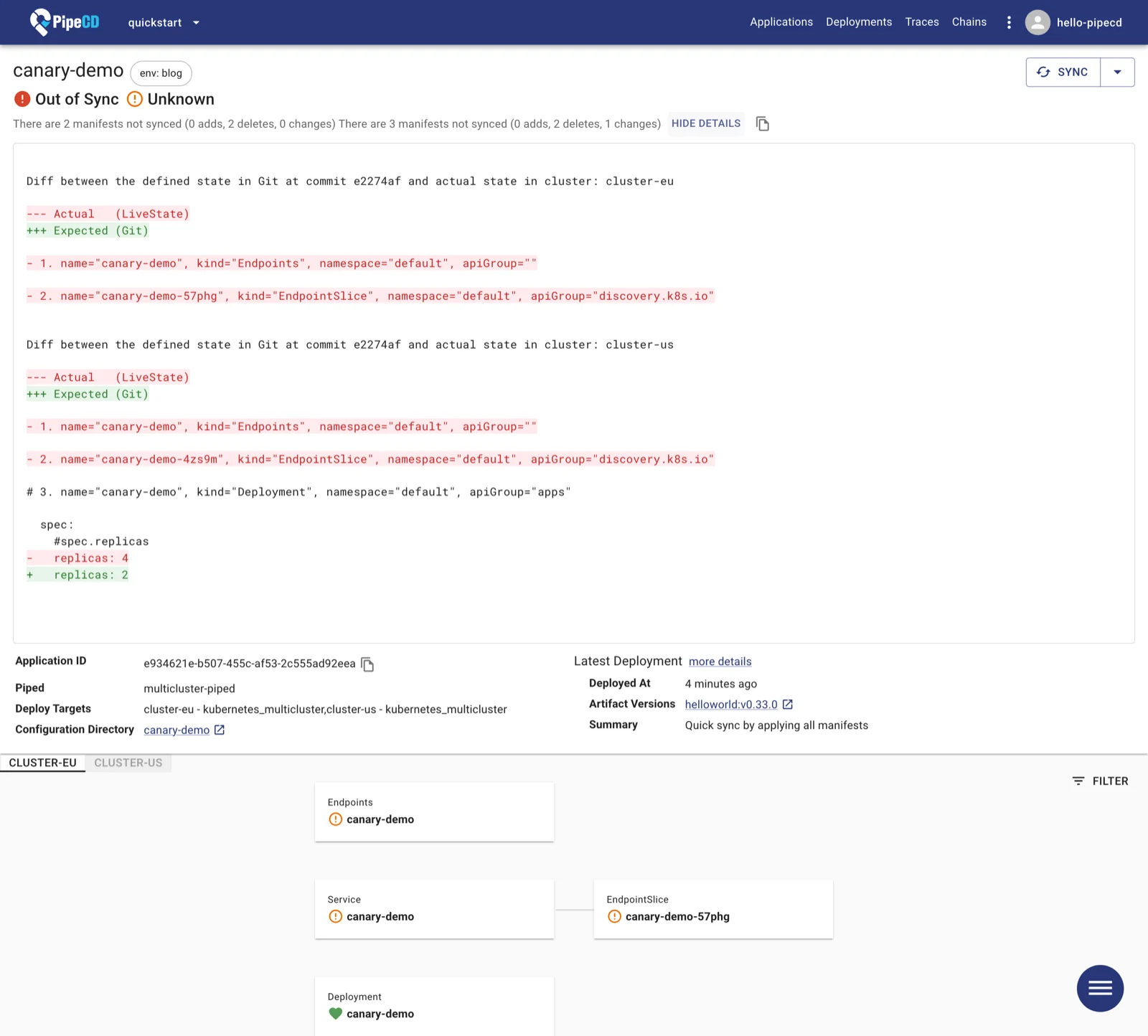
The screenshot also shows the two things that make this report noisier than it should be. The auto-generated Endpoints and EndpointSlice objects of the Service are listed as deletions, and until #7438 the plugin stamped the head commit of the repository onto the manifests it compared against, so any commit to the repository, even one for another application, reported every application as out of sync. The comparison now leaves the commit hash out.
Per-Cluster Settings
Two PRs added settings that you can now set for each cluster instead of only once for all clusters. In each case, the plugin starts with the top-level spec.input value and uses the per-cluster value instead if one is set:
kustomizeVersion := spec.Input.KustomizeVersion  // global default
if multiTarget != nil && multiTarget.KustomizeVersion != "" {
    kustomizeVersion = multiTarget.KustomizeVersion  // per-target override
}
The two additions:
kustomizeDir(#6718): the folder to use for Kustomize. This helps when each cluster uses a different overlay from the same repo.kustomizeVersionandkustomizeOptions(#6749): use a different Kustomize version or options for each cluster.
A related change that is not a setting: with #6697, StatefulSets and DaemonSets now roll out again when a ConfigMap or Secret they mount changes, as Deployments already did. The plugin adds a hash of the config data as a pod template annotation, on every cluster, with nothing to configure.
A full multi-cluster config with per-cluster settings looks like this:
input:
  multiTargets:
    - target:
        name: cluster-eu
      kustomizeDir: overlays/eu
      kustomizeVersion: "5.3.0"
    - target:
        name: cluster-us
      kustomizeDir: overlays/us
      kustomizeVersion: "5.4.0"
    - target:
        name: cluster-asia
      # no overrides, so it uses the top-level input values
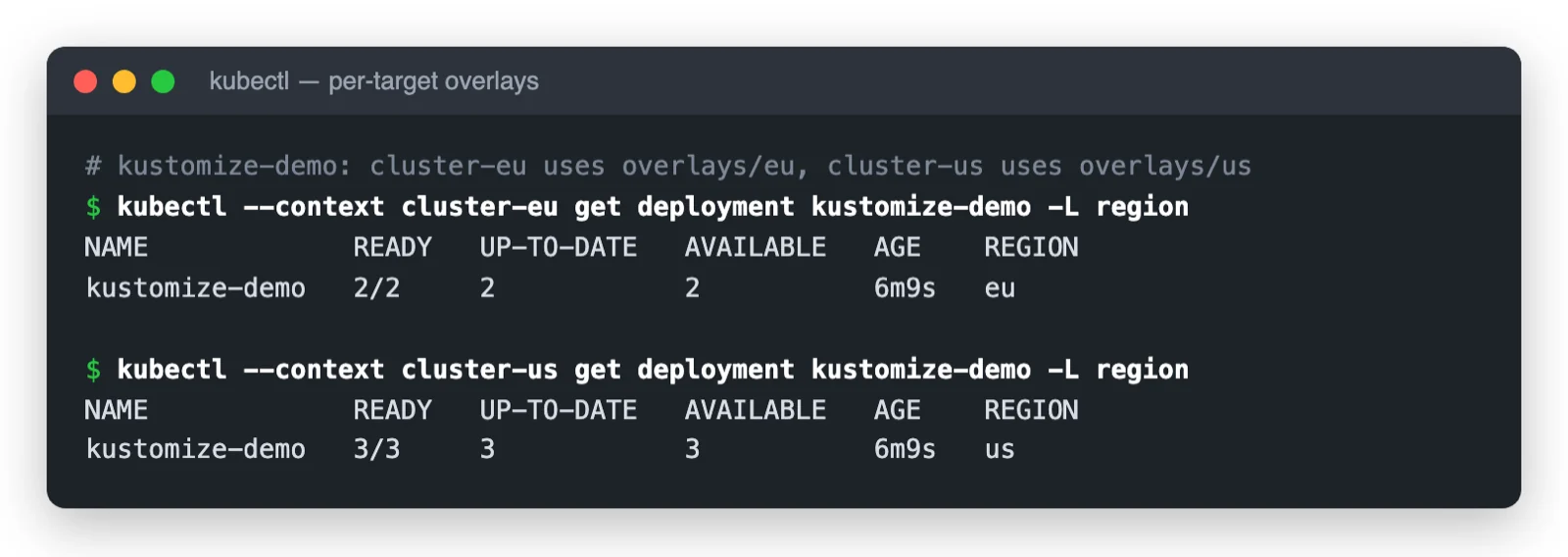
Here overlays/eu sets 2 replicas and overlays/us sets 3. One sync gives a different result on each cluster:
Stage Rename
PR #6880 added a K8S_MULTI_ prefix to the six stage names that still clashed with the single-cluster plugin (K8S_MULTI_SYNC and K8S_MULTI_ROLLBACK already had it). This was needed because the single-cluster Kubernetes plugin uses the same stage names (K8S_CANARY_ROLLOUT, K8S_PRIMARY_ROLLOUT, and so on). When both plugins were loaded together, the names clashed, and PipeCD could not tell which plugin should run the stage.
To migrate, find and replace the stage names in your pipeline YAML:
| Old name | New name |
|---|---|
K8S_CANARY_ROLLOUT | K8S_MULTI_CANARY_ROLLOUT |
K8S_CANARY_CLEAN | K8S_MULTI_CANARY_CLEAN |
K8S_BASELINE_ROLLOUT | K8S_MULTI_BASELINE_ROLLOUT |
K8S_BASELINE_CLEAN | K8S_MULTI_BASELINE_CLEAN |
K8S_PRIMARY_ROLLOUT | K8S_MULTI_PRIMARY_ROLLOUT |
K8S_TRAFFIC_ROUTING | K8S_MULTI_TRAFFIC_ROUTING |
Where Things Stand
The plugin now covers what the single-cluster plugin does for Kubernetes manifests and Kustomize, and for Helm charts kept in the application directory. Charts from a chart repository or an OCI registry follow once #7465 merges. It has six progressive delivery stages, per-stage cluster filtering, per-cluster status, plan preview, Helm/OCI login, config validation, health checks for all five workload types, better rollback, drift detection, and per-cluster settings.
The plugin is part of the open-source PipeCD project. Contributions are welcome.
A version of this post is in review for the official PipeCD blog in pipe-cd/pipecd#7464.